
How to Check Criminal History in White House
A White House records check works best when the document type comes first. Police reports remain with the city. Municipal ordinance and citation files remain with the municipal court. A state criminal prosecution moves to the county that serves the event and court. The statewide TBI record is a separate, name-based product.
- Ask White House Police for the incident, arrest, crash, or citation report by number, date, location, and involved party.
- Use the city's online public-records form or downloadable police form to request inspection or a copy of a defined White House record.
- Call the White House Municipal Court clerk for ordinance and citation matters, using the citation number and court date when known.
- For an arrest or state charge, confirm which county handled booking and prosecution, then check that county's jail and trial-court clerk.
- Use Tennessee Open Records Information Services only when a wider Tennessee name-based arrest and disposition history is needed.
These channels should not be merged. A police narrative will not contain the final disposition, and a municipal docket does not replace the Robertson or Sumner criminal courts. TORIS can show qualifying fingerprint-reported Tennessee arrests, but it cannot settle which White House file contains the best account of one event.
White House Records Cross County Lines
White House is Tennessee's state-certified second-largest Robertson County municipality, with a 2025 citywide population of 12,982. Yet the whole city is not inside Robertson County. White House also extends into Sumner County. That border is the key local fact in any criminal-record search. A citywide population or police label does not reveal which county owns a prosecution.
Start with the event address. Then read the citation, warrant, booking paperwork, or charging court. If Robertson County handled the case, the county court path leads through General Sessions and may reach Circuit Court after indictment. If the event and court fall on the Sumner side, searching only Robertson records can miss the file. The same caution applies to jail custody. Confirm both the place of the event and the office named on the case.
The official Tennessee municipal profile for White House documents the citywide figures and two-county geography. That profile also records the city's 1921 incorporation and its municipal identity.
The White House Police Department
White House Police creates reports for incidents its officers investigate. Those files can include incident and arrest narratives, crash material, citations, and related records. Request the report from the city rather than the county clerk. The clerk may have a later court case, but it does not become custodian of the investigating officer's original report.
The Police Department is at 303 North Palmers Chapel Road, White House, TN 37188, and its published phone is 615-672-4903. A useful request states the report or citation number, date and time range, exact location, subject matter, and whether inspection or a copy is wanted. Ask about the current redaction, delivery, and cost process before assuming a report can be sent at once.
The official City of White House site is the starting point for current city contacts and civic services.

The official city screen anchors the White House records process in the municipal government. It should not be confused with a county criminal docket or a statewide background search.
Inside White House's Online Records Form
The White House online public-records form gives the city a structured request. It requires the requester's first and last name, street address, city, state, ZIP, country, phone, and email. The requester chooses inspection or copy, picks a delivery method, describes the record, certifies Tennessee residency with identification, completes reCAPTCHA, and may request an emailed copy of the form.
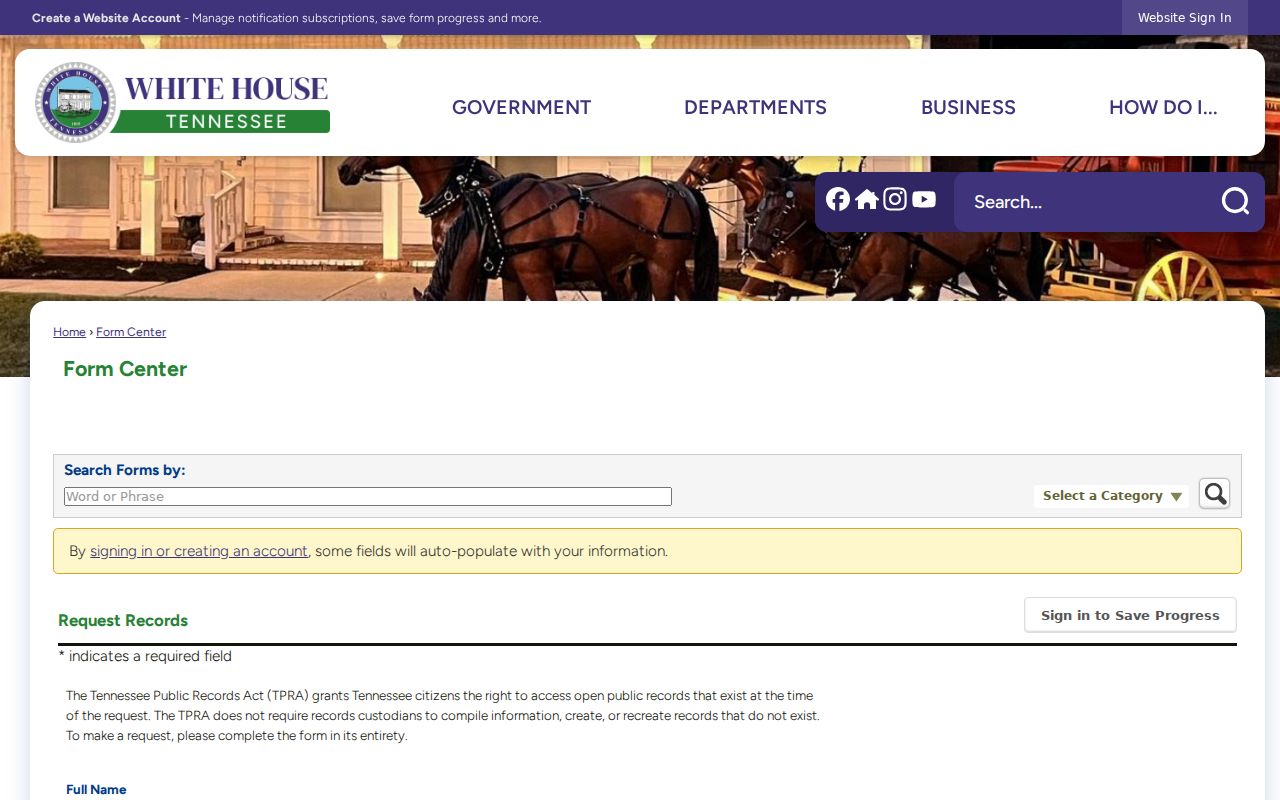
The captured form shows why precise terms matter. “All criminal records” gives the custodian little help. A report number, date range, address, citation number, and a short description point to an existing White House file.
| Form field | What to enter | Why it matters |
|---|---|---|
| Identity and contact | Name, address, phone, email | Supports response and resident verification |
| Tennessee residency | Certification and accepted ID | Documents the TPRA access right |
| Request type | Inspection or Copy/Duplicate | Sets the requested service |
| Delivery | Pickup, electronic, USPS, or other | Tells the city how to provide copies |
| Record details | Type, dates, subject, keywords | Lets staff locate the existing file |
The downloadable White House Police form covers much the same ground and adds a place to waive a cost estimate up to a requester-set ceiling. Inspection and copy are separate choices. A request can seek review of a White House record without ordering a duplicate.
The city's Records Management policy supplies the custodian context for these request choices. The form is a route to maintained city records, not a citywide name-search database.
Arrests and Bookings in White House
White House Police owns the arrest report for an arrest made by its officers. Jail staff create the booking record. The county serving the event and court determines which custody route to check, so White House arrestees should not automatically be assigned to Robertson County. Confirm the arrest location and paperwork first.
For a Robertson-side arrest, the Robertson County Detention Facility is the custody channel. Its phone is 615-384-7974. The police report stays with White House even when booking occurs at the county jail. General Sessions holds initial state charges and bond events; Circuit Court holds a felony case after indictment. The broader Robertson County arrest history process explains those county steps without replacing the city report request.
A live jail entry can roll off after release or transfer. Absence from current custody therefore does not establish that no White House arrest occurred. Ask for the booking record and follow the correct court file when a past event is the issue.
Tracing White House Arrest Records
Use the record itself to resolve the county line. A citation can name the court. A booking record can identify the jail and arresting agency. A warrant can name the issuing court. When those clues conflict, call the city police records contact and the named clerk instead of searching both counties by guesswork.
- Incident report
- The White House Police account of the event or investigation.
- Booking record
- The receiving jail's intake, charge, bond, hold, custody, and release data.
- Municipal citation
- A city matter alleging a White House ordinance violation.
- State criminal case
- A misdemeanor or felony prosecution filed in the proper county court.
Each item has its own custodian. Matching a name is not enough, especially when the same city name appears on records from two county systems. Dates, citation or case numbers, and court names provide a safer match.
White House Municipal Court Records
White House Municipal Court hears municipal ordinance violations. It is not the felony trial court and does not replace a county search for state charges. The municipal clerk is Christa Elliott, and the published contact is 615-672-4350 extension 2137. If a citation lacks a court date, call that office rather than infer a date from another notice.
The official White House Municipal Court page identifies the city's limited ordinance jurisdiction.
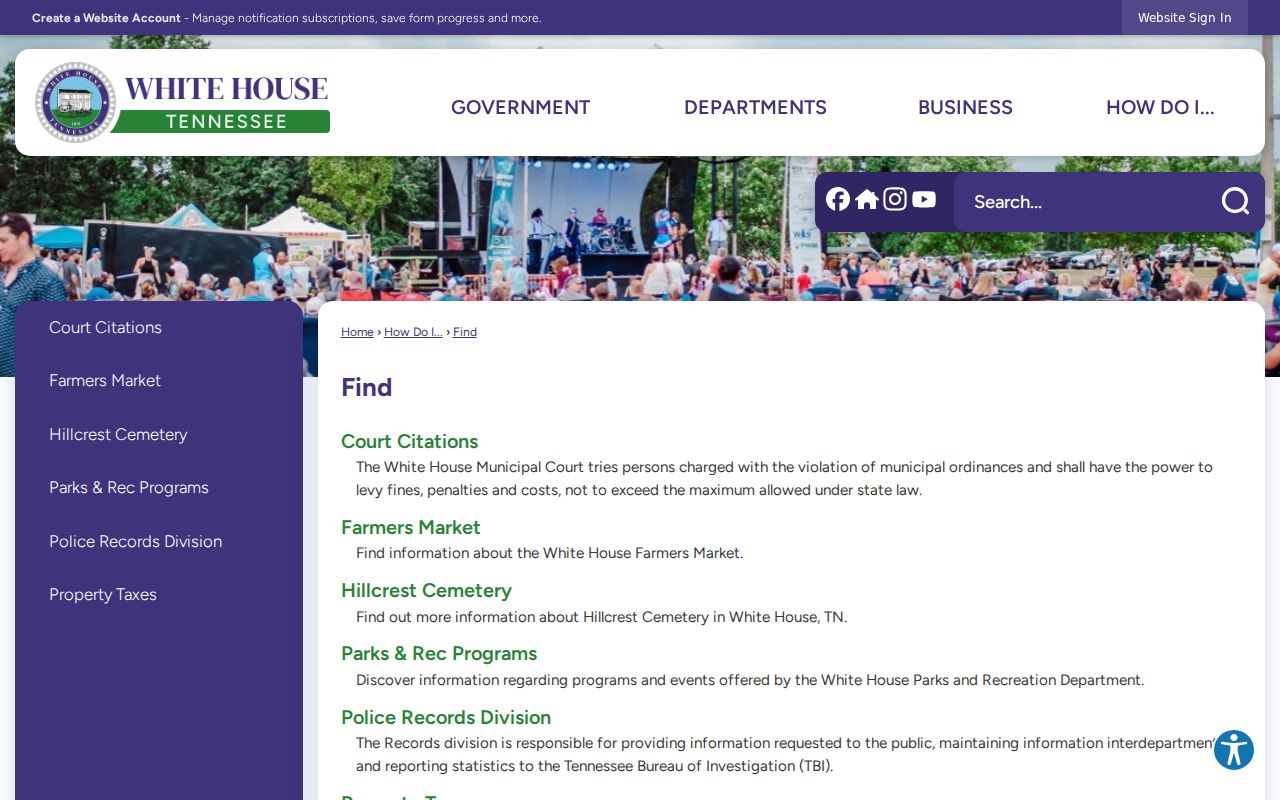
The city court screen marks the local record slice. A filed ordinance case may document a citation and city disposition, while a Robertson or Sumner court file is needed for a state criminal charge.
| Court Name | White House Municipal Court |
|---|---|
| Case Types Heard | Municipal ordinance violations and city citations within its jurisdiction |
| Lookup Channel | Municipal clerk by citation number, name, and date; no verified public name-search portal |
| Record Contents | Citation, docket events, hearing information, disposition, penalty, and payment-plan activity when applicable |
| Copies and Fees | Ask the clerk or use the city request process for current copy terms |
Electronic White House Citation Records
White House's current internal controls give a rare view into how municipal records develop. Police electronic citations are imported before the court docket. After disposition, citations are scanned by number. The controls also describe a payment-plan worksheet and same-day hearing workflow. These steps create different dated entries inside one city matter.
The 2025 municipal-court update retained the court's ordinance jurisdiction and lawful civil-penalty authority. It did not turn the municipal court into a Robertson County criminal court. When a citation is missing a date or a payment-plan hearing is unclear, the White House clerk is the right contact. When a state charge appears, follow the county court named on the charging record.
Note: A White House ordinance disposition should not be labeled a Tennessee criminal conviction without checking the charging authority and cited law.
Where White House Records End Up
A White House report begins with city police, but a state prosecution leaves city hands. On the Robertson side, General Sessions receives misdemeanor matters and the early steps of felony cases. Circuit Court becomes the felony trial court after indictment. The clerk later sends qualifying dispositions to the Tennessee Bureau of Investigation.
Record flow: White House Police Department › Correct County Court › Tennessee Bureau of Investigation
This flow is not a promise that every screen updates at once. Police keep the incident narrative. The jail keeps custody facts. The clerk keeps the filed charge and judgment. TBI links a reported disposition to the fingerprint arrest cycle. If the arrest label differs from the judgment, the certified county disposition is the best source for the final result.
White House Record Delivery Choices
The city form lets a requester choose on-site inspection, electronic delivery, USPS first-class mail, or another approved method. That choice can affect cost and timing. Inspection is generally free under Tennessee's statewide guidance. Copies and labor may be charged under the city's lawful policy, and a custodian may ask for advance payment.
| Choice | Best fit | Point to confirm |
|---|---|---|
| Inspection | Review before deciding which pages are needed | Appointment and record availability |
| Electronic | Records already held in a sendable format | Redaction and file-size limits |
| Pickup | Paper or media collected at a city office | Office and pickup notice |
| USPS | Paper copies sent by first-class mail | Copy, postage, and prepayment amount |
The city need not create a new analysis or compile facts that do not exist in a maintained record. Narrow dates and keywords help White House staff find responsive material and allow the requester to set a sensible cost ceiling.
Public Access Rules
White House police and municipal records are subject to the Tennessee Public Records Act unless a statute or court order restricts access. The enforceable right belongs to Tennessee citizens, and the city may verify residency. Inspection requests need not be written under state guidance, though a copy request may be required on the city's form. If records cannot be produced promptly, the custodian generally has seven business days to produce them, deny access with a legal basis, or provide an estimated production time.
Key statutes:
Tenn. Code Ann. §10-7-503 gives Tennessee citizens access to state and local public records, subject to exceptions and response rules.
Tenn. Code Ann. §10-7-504 identifies confidential material that must be withheld or redacted.
Tenn. Code Ann. §38-6-120 supports TBI dissemination of Tennessee criminal-history checks through TORIS.
Active investigative material, sealed or expunged files, juvenile information, protected victim or minor data, medical details, and security-sensitive information may not be available. A partial response does not mean the city has hidden a complete public file. It may reflect a legal redaction or another custodian's ownership.
When White House Records Do Not Exist
A White House request form helps the city find records it keeps. It cannot make a county judgment, create a research summary, or produce a police file held by another agency. If the city says no responsive record exists, check the incident location, arresting agency, citation heading, and court. A sheriff's deputy response may route the report to Robertson or Sumner rather than to White House Police.
For an older Robertson-side prosecution, contact the county trial-court clerk and consider the Robertson County Archives when the clerk routes historical material there. For a broader statewide name check, TORIS is the Tennessee repository route. Keep each fallback tied to the document needed. That approach preserves White House city altitude while avoiding a false “no record” conclusion from the wrong office.