
Criminal Cases in the Robertson County Courts
Robertson County criminal cases split by court level. The Circuit Court of the 19th Judicial District is the felony trial court. General Sessions hears misdemeanors, issues and handles warrants, conducts initial appearances, and receives felony complaints before a preliminary hearing or waiver sends the case toward the grand jury. The Circuit Court Clerk and General Sessions Clerk keep those court files at the courthouse complex in Springfield.
A municipal citation follows a narrower path. Springfield, White House, and Greenbrier municipal courts keep their own ordinance and citation records. Those city files do not replace a Robertson County search for a state misdemeanor or felony. White House also spans Robertson and Sumner Counties, so the event location and charging court matter more than the mailing city. The court named on the citation, complaint, or case number is the best first clue.
The Tennessee court listing for Robertson Circuit and Criminal Court shows the county courthouse entry used by court searchers.
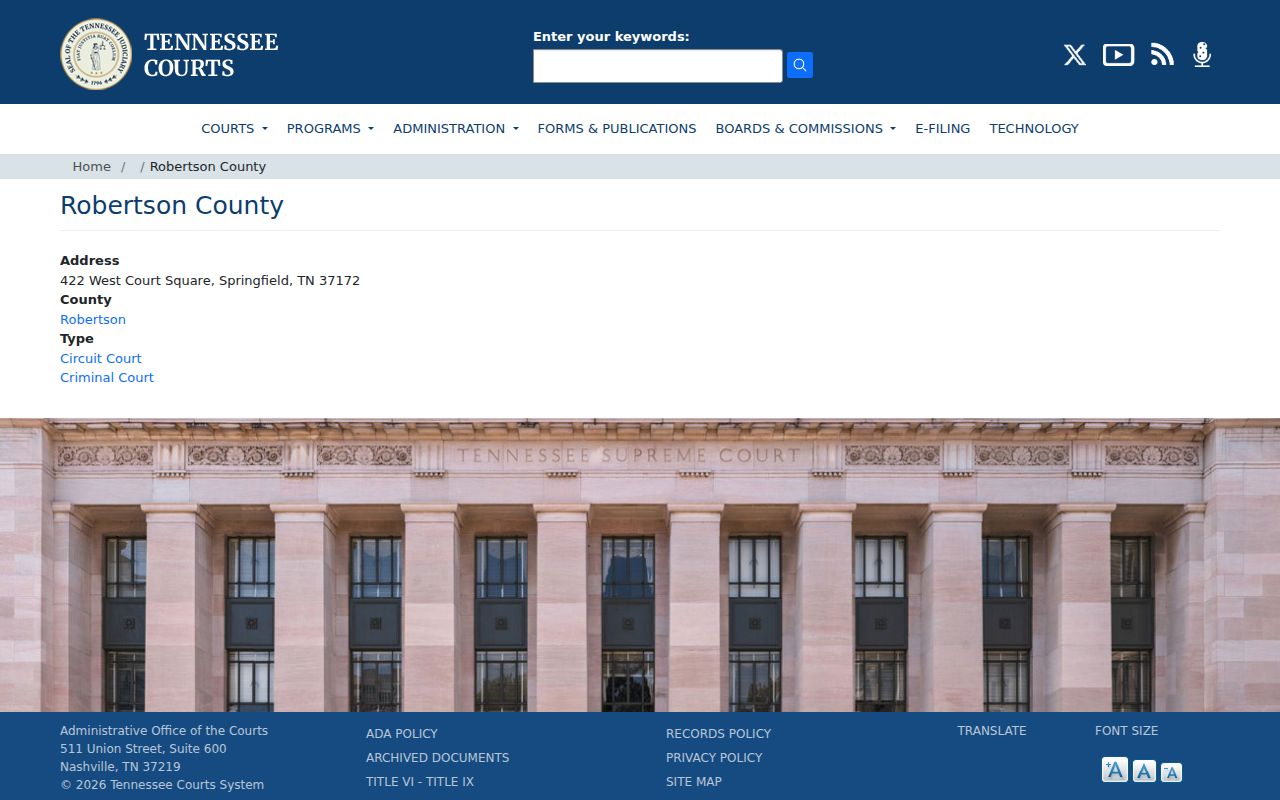
That listing anchors a Robertson County felony-case request to the proper trial court rather than to the sheriff or jail.
Robertson County Sessions Case Records
General Sessions is the front door for much of the Robertson County criminal docket. A sworn complaint may begin there. The court may record an initial appearance, appointment of counsel, bond terms, a misdemeanor plea, or the preliminary steps in a felony prosecution. If a felony charge is bound over or waived, later filings may appear under a new Circuit Court case number after grand-jury action.
This split can trip up a name search. A Sessions result may end before any final felony judgment appears in that file. The grand jury may return a true bill, decline with a no-bill, or the prosecutor may pursue a different count. Searchers should ask the clerk whether a related Circuit case exists and use the defendant name, date range, and Sessions number to connect the records. A municipal ordinance case, by contrast, may never enter this county criminal chain at all.
- Complaint
- A sworn charging claim that often starts a General Sessions case.
- Indictment
- The grand jury's formal accusation that moves a felony into Circuit Court.
- Disposition
- The outcome of one charge, such as conviction, dismissal, or acquittal.
- Capias
- Court process that commands an arrest, often after a missed appearance or judgment.
How to Search Case Records
Tennessee does not provide a complete free statewide public search for Robertson County trial cases. Build the request around the court that heard the matter. A full legal name, a narrow date span, the likely court level, and any case or citation number reduce mistaken matches. Date of birth can help the clerk distinguish people with the same name, though protected identifiers may not appear in a public copy.
- Identify whether the record belongs to General Sessions, Circuit Court, or a municipal court.
- Give the clerk the full legal name, filing or offense date range, and case number when known.
- Inspect the docket for a related Sessions or Circuit number and verify the court and defendant.
- Open the charging document, judgment, and sentence entries instead of relying on the case caption alone.
- Request a certified disposition from the clerk when the official result of the case is required.
If the current clerk search does not reach the needed year, move to the Robertson County Archives. An online miss does not prove that no file exists.
Robertson Criminal Papers in Archives
The Robertson County Archives search is unusually useful for criminal case research. Its named groups include Criminal Court Papers from 1900 through 2016, General Sessions Court Index entries from 1947 through 1994, and Circuit Court civil and criminal testimony transcriptions from 1932 through 1962. The catalog can point to older Robertson County criminal records that are absent from a modern clerk view.
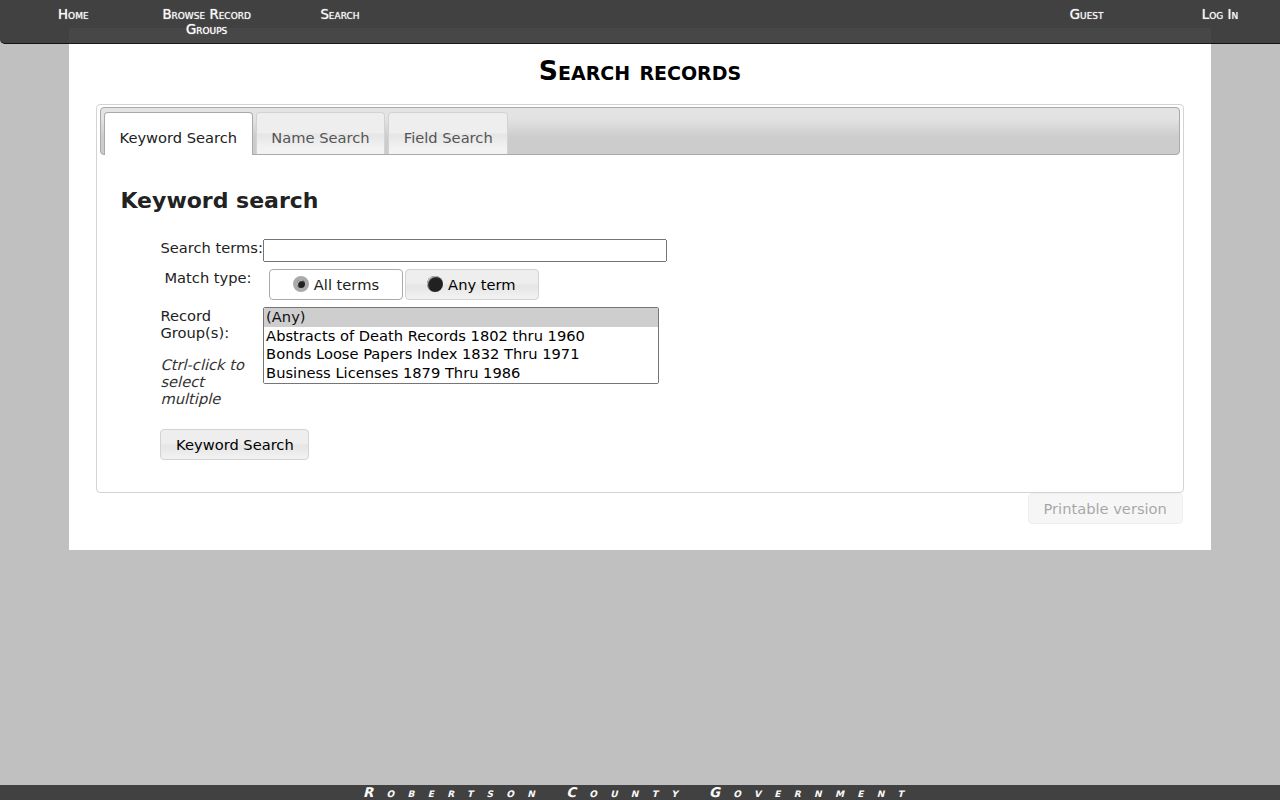
The screen exposes three routes, so a searcher can switch from broad terms to a surname or a selected record group.
| Field Label | Type | Required | Notes |
|---|---|---|---|
| Search mode | Tabs | Yes | Keyword Search, Name Search, or Field Search |
| Search terms | Text | Keyword mode | Match all terms or any term |
| Record Group(s) | Multi-select | No | Choose criminal papers, Sessions indexes, or testimony records |
| Last Name | Text | Name mode | Use the surname and add the first name when possible |
| Record Group | Dropdown | Field mode | Group-specific fields appear after selection |
An index hit is a finding aid, not proof that the full paper is online. Give the hit details to Archives or the clerk and ask where the underlying file is stored. Note: Call before travel because an active file may be at the courthouse, off-site, or transferred to Archives.
What the Case File Shows
A Robertson County case file is event-centered. It follows the charge that the prosecutor filed, not merely the label used at arrest. Read it count by count because one complaint can lead to an amended charge, an indictment with different counts, a plea on some counts, and dismissal of others. The judgment and disposition entries provide the most reliable public account of the result.
| Case Number & Court | The file identifier, division, judge, filing date, and case status. |
|---|---|
| Charging Document | The complaint, information, or indictment with offense description, Tennessee citation, class, and count. |
| Docket Entries | A dated register of appearances, motions, grand-jury action, pleas, trial, and later filings. |
| Hearing Dates | Scheduled and completed events, which may include arraignment, preliminary hearing, or sentencing. |
| Disposition & Judgment | The result for each count, such as conviction, dismissal, acquittal, or nolle prosequi. |
| Sentence & Conditions | Confinement, probation, fines, costs, restitution, concurrent or consecutive terms, and violations when public. |
Public copies may redact Social Security numbers, account data, protected addresses, and full identifiers for minors or victims. Document access also varies. A docket entry can name an order even when the document image is not remotely available.
Robertson Charges and Judgments Differ
A complaint, indictment, and judgment mark separate legal acts. The complaint states the sworn allegation that starts many Sessions matters. An indictment records the grand jury's formal felony accusation. A judgment states how a court resolved a count and what sentence followed. Treating these documents as interchangeable can turn an early claim into a false account of the final Robertson County outcome.
| Document | Who Creates It | What It Proves |
|---|---|---|
| Complaint | Affiant and issuing judicial process | An allegation supported for the case to begin |
| Indictment | Grand jury | Probable cause for the filed felony accusation |
| Judgment | Circuit or Sessions court | The disposition and sentence for each resolved count |
For a final answer, obtain the certified judgment or certified disposition from the Robertson County clerk. A screen print, booking charge, or old arrest report is not a substitute.
Stages of a Criminal Case
A Robertson County prosecution may begin with an arrest or citation, followed by booking, an initial appearance, and bond. A misdemeanor can remain in General Sessions. A felony usually proceeds from the complaint to a preliminary hearing or waiver and then to grand-jury review. If indicted, the Circuit file records arraignment, discovery, motions, a negotiated plea or trial, judgment, sentence, and any post-trial motion or appeal.
Case flow: Charges Filed › Arraignment › Pretrial › Plea or Trial › Disposition › Sentencing
The path explains why a new Robertson County case may seem incomplete. Each stage creates a record at a different time, and the arrest charge can change before judgment. The District Attorney General for the 19th Judicial District prosecutes state cases, but the clerk, not the prosecutor, is the custodian for a certified court result.
Read Robertson County Docket Events
Short docket terms carry major consequences. Bond describes the terms or security for release while a case is pending. Recognizance means release on a promise and conditions rather than secured money. A plea is the defendant's formal response. Nolle prosequi means the prosecutor formally chose not to press that charge at that time. Judicial diversion can defer judgment during supervision for a qualified person.
Probation is a sentence served under community supervision. Parole is supervised release after prison through the Tennessee Board of Parole. A probation order in a Robertson County judgment is public evidence of the sentence, but an officer's supervision notes and treatment data are not the public docket. Read violations and later orders before assuming the original sentence remained unchanged.
When the docket uses a term without a clear count reference, ask the clerk which charge the event affects. Note: A dismissal can end a count without automatically removing every booking or repository entry.
Federal Cases Beyond Robertson Courts
Federal charges from Robertson County belong to the U.S. District Court for the Middle District of Tennessee, not the county clerk. PACER is the official federal docket channel. Registration is required, page fees generally apply under current Judicial Conference rules, and a quarterly low-use waiver may apply. A person can also be held at the Robertson County Detention Facility for a federal system while the criminal docket exists only in federal court.
The federal portal is therefore a separate layer, used only after the prosecuting jurisdiction points beyond Robertson County courts.
Access & Restrictions
The Tennessee Public Records Act guidance explains that Tennessee citizens may inspect state and local public records subject to legal exceptions. Ask the custodian that keeps the record: the Robertson County clerk for dockets and judgments, a city clerk for municipal files, or Archives for transferred historical material. Inspection is ordinarily free. Written requests, an estimate, and payment may apply to copies or certified records.
The state guidance helps frame a precise request, but court rules and confidentiality laws still control what the clerk may release.
Access rule: Tenn. Code Ann. §§10-7-503 and 10-7-504 support access while protecting records made confidential by law.
Juvenile files, sealed or expunged matters, protected victim and minor details, account numbers, and other confidential identifiers may be withheld or redacted. Grand-jury deliberations remain secret, though a filed indictment becomes part of the court file unless sealed. If a Robertson County name search returns nothing, ask whether the file is under a different number, stored off-site, transferred to Archives, or restricted by an order. The broader Robertson County criminal-history overview explains how court, jail, and TBI records differ.