
How to Check Criminal History in Robertson County
No single Robertson County database contains every criminal record. Start with the source closest to the event. The Circuit Court Clerk holds felony case files and General Sessions files at the courthouse in Springfield. The Robertson County Archives indexes older criminal papers. The Detention Facility handles current and recent booking questions, while the Sheriff's Records Division maintains deputy incident and arrest reports. A broader Tennessee history comes from the Tennessee Bureau of Investigation, not from the county clerk.
Gather a full legal name, likely spelling variants, an approximate date, and any known case, incident, booking, or warrant number. A date of birth helps separate people with similar names, but public access to identifiers can be limited. Follow the record from its first custodian to the final court outcome. A booking charge may change before indictment or judgment.
- Identify whether the needed item is a police report, jail booking, court file, statewide history, or supervision record.
- Ask the owning office by full name, date range, and the most precise record number available.
- Use the Robertson County Archives search for indexed older criminal papers and Sessions material.
- Compare an arrest or booking with the clerk's filed charge, docket, and certified disposition.
- Use TORIS for Tennessee-wide history and FOIL only for felony custody or supervision through TDOC.
Four Robertson Criminal Record Views
The same Robertson County event can create four records with different purposes. The arresting agency writes a report about the event and probable cause. Jail staff create a custody file with booking time, initial charges, bond, holds, and release data. The court clerk opens a case file when a complaint, indictment, or other charging paper is filed. TBI builds a person-centered history from reportable fingerprint arrest cycles and later dispositions.
Those files are not duplicates. A sheriff report may remain while a charge is amended. A jail entry can show an initial allegation that never becomes the final count. The clerk's judgment is the strongest source for the outcome of a Robertson County prosecution. TORIS may lag when a disposition is late, incomplete, or cannot link to the arrest cycle.
Record flow: Agency report → Detention Facility booking → General Sessions complaint → Circuit indictment when applicable → judgment and disposition sent to TBI.
Official Tennessee Background Checks
The Tennessee Bureau of Investigation Criminal Records Unit runs Tennessee Open Records Information Services, known as TORIS. Any requester may order a $29 Tennessee name check. The fee is nonrefundable. TORIS searches Tennessee misdemeanor and felony arrests created from fingerprint submissions and linked dispositions, but it does not search other states, federal records, or aliases as part of the name match.
For self-review, a person can use TORIS for Tennessee records or request an FBI Identity History Summary with fingerprints for federal identity history. Tennessee Applicant Processing Services, using IdentoGO enrollment sites, handles checks authorized by a statute or requesting agency. TAPS registration requires that agency's OCA code, and its fee varies by program. It is not a general walk-in Robertson County name search.
The FBI self-check portal shows the federal request route used when a fingerprint-based personal history is needed.
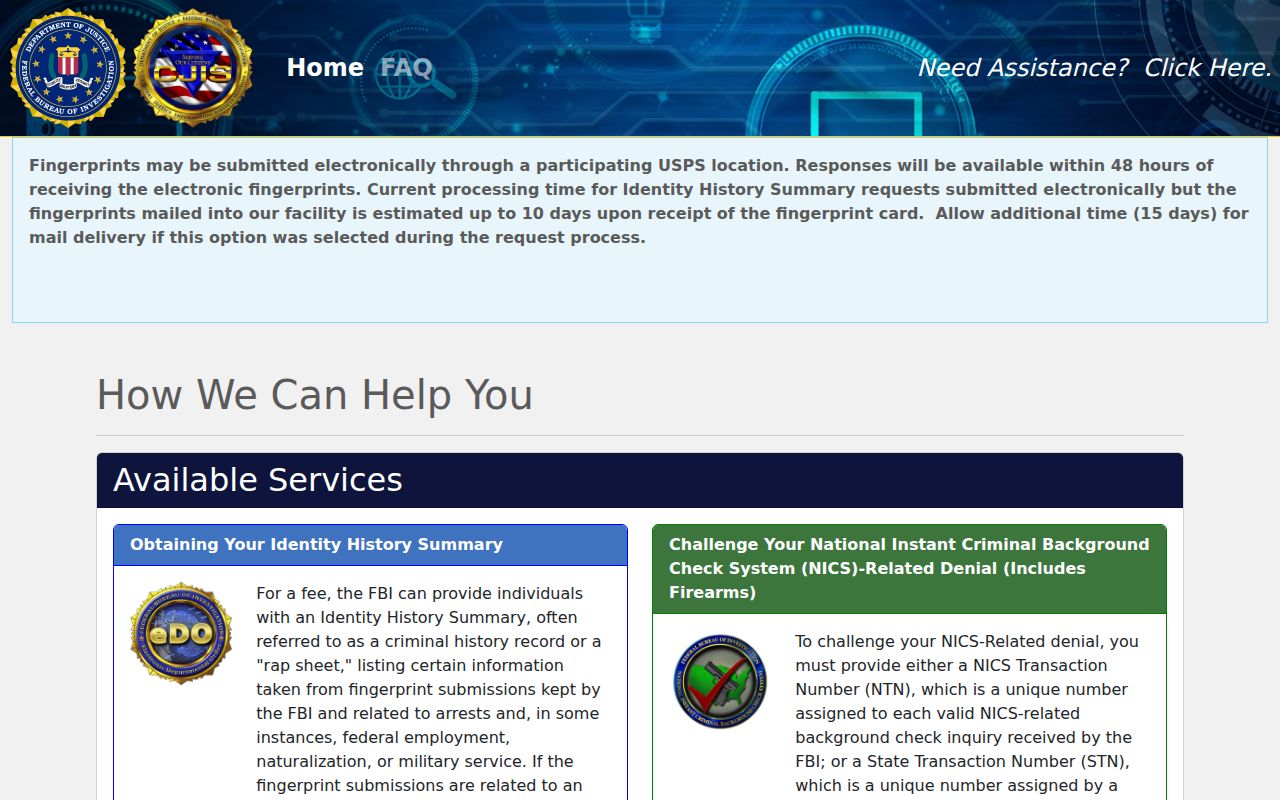
The federal result has a different scope from Robertson court records and a Tennessee TORIS name check.
Inside Robertson County TORIS Searches
TORIS is useful when the question goes beyond one Robertson County case. The landing page separates credit-card customers from billable accounts. Visa, MasterCard, and Discover are accepted, while American Express is not. A paper application can use the listed check, money-order, cashier's-check, or supported card routes. TBI notes that results paid by personal check may be held about seven to ten days for clearance.
The first online screen gathers requester details, not the subject search itself. Accuracy matters because the public product is name-based. For a disputed entry on one's own TORIS report, TBI offers a $24 fingerprint comparison after prints are obtained from local law enforcement and sent with the required dispute material.
| Product | Identity method | Published cost |
|---|---|---|
| TORIS Tennessee history | Name and demographics | $29 |
| TORIS entry dispute | Fingerprint comparison | $24 |
| TAPS authorized check | IdentoGO fingerprints and OCA | Program-specific |
| Robertson court inspection | Name, date range, or case number | Inspection generally free |
The official TORIS entry page displays the customer routes before the requestor form.
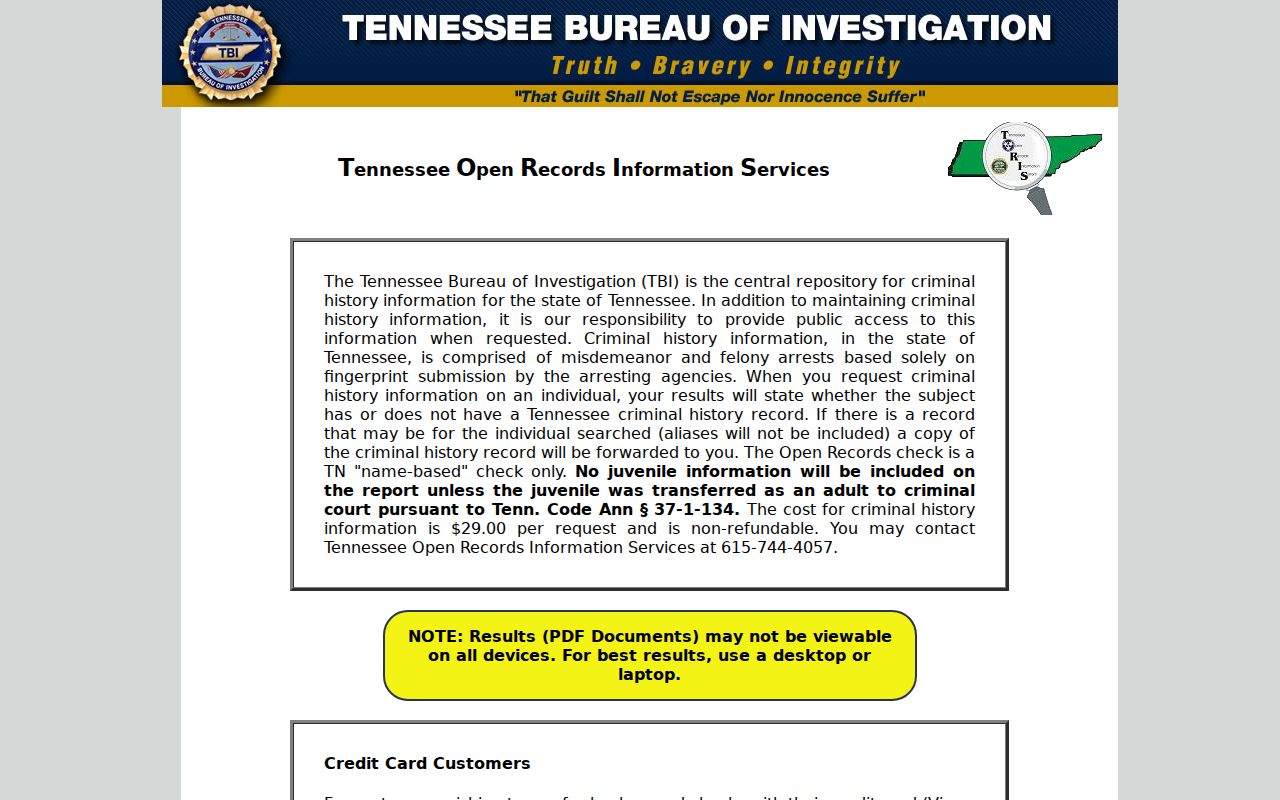
That state portal complements local records; it does not replace a Robertson County certified court disposition.
Types of Criminal Records
Robertson County records differ by who creates them and what stage they document. An incident report describes the response and investigation. A booking file records custody. A complaint or indictment states an accusation, while a judgment records the court's resolution. A warrant directs an arrest or another judicial act. None should be read as a substitute for all the others.
County jail data covers pretrial and short-term custody. The Tennessee Department of Correction's Felony Offender Information Lookup covers people who are or were in TDOC felony custody or supervision. The Tennessee Sex Offender Registry is a separate public-safety system for qualifying registrations. Probation orders live in the court file, while detailed supervision notes are not the public docket.
- Arrest and booking: agency narratives, intake data, initial charges, bond, holds, and release.
- Court case files: complaints, indictments, motions, docket entries, judgments, and sentences.
- State history: fingerprint-reported Tennessee arrest cycles and linked dispositions in TORIS.
- Warrants: court-issued process, which is broader than the sheriff's selected Most Wanted notices.
- Custody and registry: county jail, TDOC FOIL, parole, probation, and qualifying registry data.
Robertson Sheriff Records Channels
The Robertson County Sheriff's Records Division maintains the office's public-record system and handles Tennessee Incident Based Reporting System duties. Ask for an existing record with an incident number, approximate date and time, place, party, deputy, booking number, or warrant and case number. A broad request to research everything about a person may not identify an existing record well enough for the custodian to act.
The division is at 507 South Brown Street in Springfield and uses 615-384-7971 and fax 615-382-0641. The Detention Facility is a separate stop at 311 Fifth Avenue East, with 615-384-7974 for booking or current custody questions. The sheriff site does not publish a complete copy-fee schedule, fixed turnaround promise, or local clearance-letter product. Confirm cost and delivery before requesting copies.
The official Records Division page identifies the unit that manages Robertson County sheriff records.
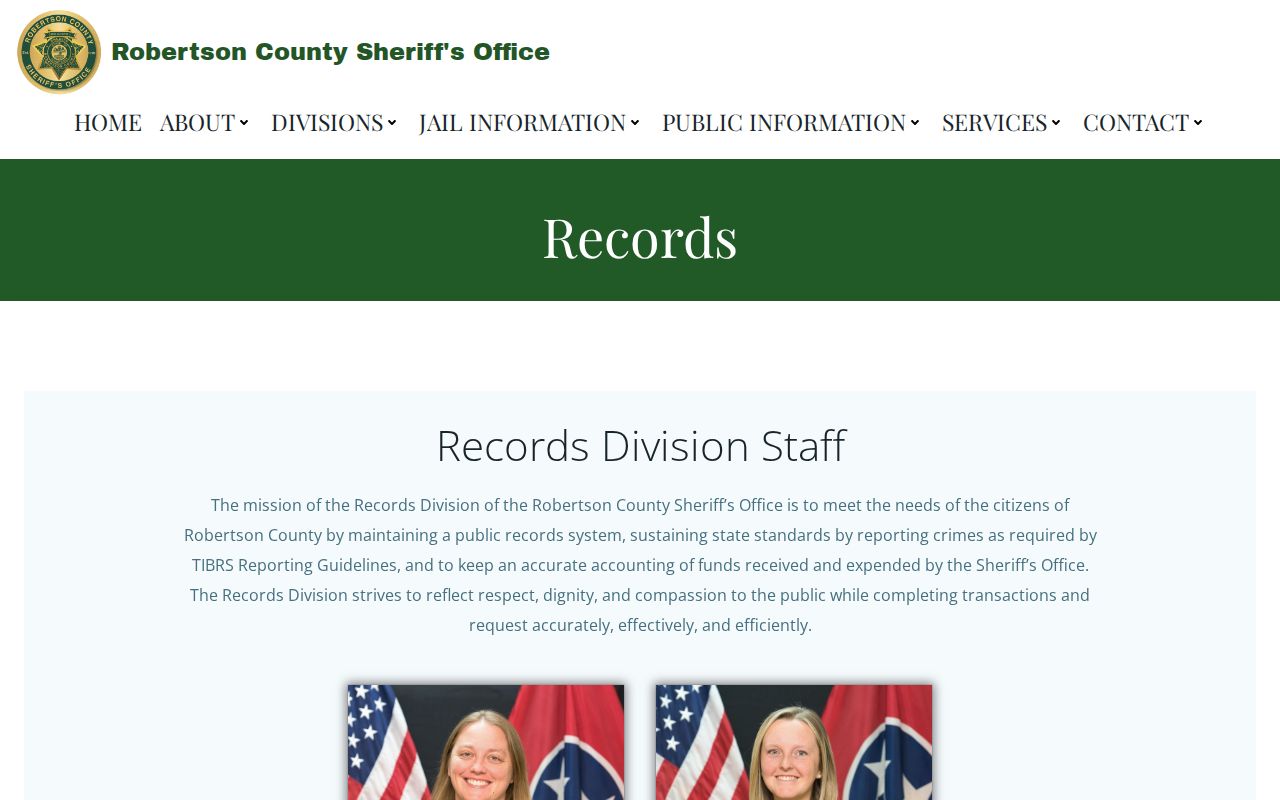
The page helps route deputy report requests, while court outcomes still belong with the clerk.
What a Robertson County Criminal Record Shows
A Robertson County record may show subject identifiers, an agency and date, charge text, Tennessee Code citations, bond, docket events, disposition, sentence, and supervision. The exact fields depend on the source. TORIS groups fingerprint arrest cycles and linked outcomes. A court case adds attorneys, count-by-count pleas and judgments, fines, costs, restitution, and appeal references. A jail file adds custody and release context.
| Name & Identifiers | Reported name, birth date, sex, race, and SID or FBI identifiers where public. |
|---|---|
| Arrest / Booking Data | Agency, date and time, booking number, initial charges, bond, holds, and release. |
| Charges & Statutes | Complaint or indictment counts, offense wording, code citation, and class. |
| Disposition | Conviction, dismissal, acquittal, nolle prosequi, or another count-specific result. |
| Sentence | Custody term, probation, fines, costs, restitution, and concurrent or consecutive terms. |
| Custody / Supervision Status | County custody, TDOC status, active sentence, probation, or parole where public. |
Protected personal identifiers, victim and minor data, medical screening, and jail-security details can be redacted. Match the person with more than a name, then obtain the certified disposition when the precise outcome matters.
Robertson Criminal Papers Since 1900
The Robertson County Archives catalog is more than a genealogy tool. It lists Criminal Court Papers from 1900 through 2016, General Sessions Court Index material from 1947 through 1994, and Circuit Court civil and criminal testimony transcriptions from 1932 through 1962. This makes the archive a key fallback when a modern clerk search does not surface an older Robertson County criminal case.
Searchers can choose Keyword, Name, or Field Search. Keyword mode can match all or any terms and can be narrowed by record group. Name mode accepts first and last names. Field Search starts with a record-group choice. An online hit is an index pointer, not proof that the paper itself is digitized. Use the result to ask Archives or the clerk for the underlying record.
| Archives field | Use | Search note |
|---|---|---|
| Search mode | Keyword, Name, or Field | Choose the route that fits the known fact |
| Search terms | One or more words | Keyword mode can match all or any terms |
| Record Group | Narrow by collection | Select criminal papers, Sessions index, or testimony |
| First and Last Name | Find a named index entry | Use both where possible |
Note: A blank modern search cannot prove that Robertson County has no older court file in storage or the county archive.
Public Access Laws
The Tennessee Public Records Act gives Tennessee citizens access to state and local public records, subject to statutory exceptions. The practical rule is to ask the custodian that created or keeps the item. In Robertson County, the clerk holds court files, the sheriff holds deputy and jail records, city police keep their reports, and TBI supplies the statewide history. The Act is an access law, not one central name-search service.
Key Statutes:
Tenn. Code Ann. §10-7-503 gives citizens access to public records and sets response rules.
Tenn. Code Ann. §10-7-504 collects confidentiality rules that require withholding or redaction.
Tenn. Code Ann. §38-6-120 supports TBI criminal-history dissemination through TORIS.
Tenn. Code Ann. §40-32-101 governs Tennessee expunction.
Tenn. Code Ann. §§40-39-201 et seq. governs registry reporting and public access.
Inspection is ordinarily free. Copy and labor charges can apply, and an agency may verify Tennessee citizenship. If records cannot be produced promptly, the custodian generally has seven business days to produce them, deny the request with a legal basis, or provide an estimated production time.
Robertson Jail and Custody Records
The Robertson County Detention Facility creates a booking record when a person enters custody. Corrections staff take fingerprints, inventory property and money, screen for health and safety needs, track warrants and holds, and maintain release data. Public fields may include a name, booking identifier and time, arresting agency, initial charges, bond, holds, custody status, and release. Medical, mental-health, classification, and security details are not ordinary public fields.
When the sheriff's Inmate Info link does not load, call the Detention Facility at 615-384-7974. TN SAVIN and VINE add free custody status and release, transfer, or escape alerts. Registration can use a name or booking number and may be anonymous. The service warns users not to rely on it as the sole safety notice.
FOIL comes later if a person enters TDOC felony custody or supervision. It is not a full Robertson County arrest search. Federal custody has yet another source, the federal Bureau of Prisons locator.
Sealed, Expunged & Restricted
Juvenile records are generally confidential. TORIS includes juvenile information only when the case was transferred for adult prosecution. Robertson County agencies may also redact Social Security numbers, account details, protected victim or minor data, health information, and security-sensitive jail material. A sealed record has restricted access; an expunction order directs the handling or removal of eligible records under Tennessee law.
Tennessee does not erase every record on request. Non-conviction outcomes such as an acquittal, dismissal, nolle prosequi, or no true bill often follow a different route from eligible convictions. Judicial diversion can support expunction after successful completion. Limited conviction eligibility depends on the exact offense, sentence completion, waiting period, and exclusions. The withdrawn 2025 proposal for shorter waits did not become law.
Robertson County Expunction Route
File with the court that handled the Robertson County case. First obtain the case number and certified disposition from Circuit, General Sessions, or the municipal clerk. Ask that clerk for the current uniform petition and order, an itemized fee quote, and routing instructions. Non-conviction expunction is generally fee-free. A conviction petition has historically carried a $350 statutory fee, but the current clerk assessment must be confirmed before filing.
The district attorney checks eligibility and may object. After a judge signs the order, keep certified copies and allow the clerk, TBI, and arresting agency time to process it. Then review the county index and one's own TORIS result. If an entry remains, send the certified order and exact identifiers to the reporting custodian and TBI. A dismissal alone does not automatically clear each copy.
Robertson County Warrant Checks
The sheriff's Most Wanted page is a selected publicity list, not a complete Robertson County warrant database. Its absence cannot clear a warrant. Call the sheriff at 615-384-7971 or dispatch at 615-384-4911 for sheriff warrant routing. Bench warrants and capias matters also require contact with the exact General Sessions, Circuit, or municipal court that issued the process. Counsel can contact the issuing court when a person needs to resolve their own warrant.
The official Most Wanted page may show selected charges and identifying details, and it tells the public not to attempt an arrest. Sealed warrants, juvenile process, active investigative material, and unserved sealed indictments can remain unavailable. Confirm service or recall status with the court and sheriff rather than relying on an old screenshot.
Robertson Criminal Record Custodians
Three Robertson County offices within Springfield answer different questions. The Circuit and Criminal Court clerk serves case files and certified outcomes. The Sheriff's Records Division handles deputy reports. The Detention Facility answers custody and booking questions. Calling first is wise because a court file may be active, stored off-site, or transferred to Archives.
Circuit and Criminal Court
422 West Court Square
Springfield, TN 37172
Felony dockets, judgments, and certified dispositions
Sheriff's Records Division
507 South Brown Street
Springfield, TN 37172
615-384-7971
Detention Facility
311 Fifth Avenue East
Springfield, TN 37172
615-384-7974
The sheriff's contact page places the law-enforcement and detention contacts side by side.
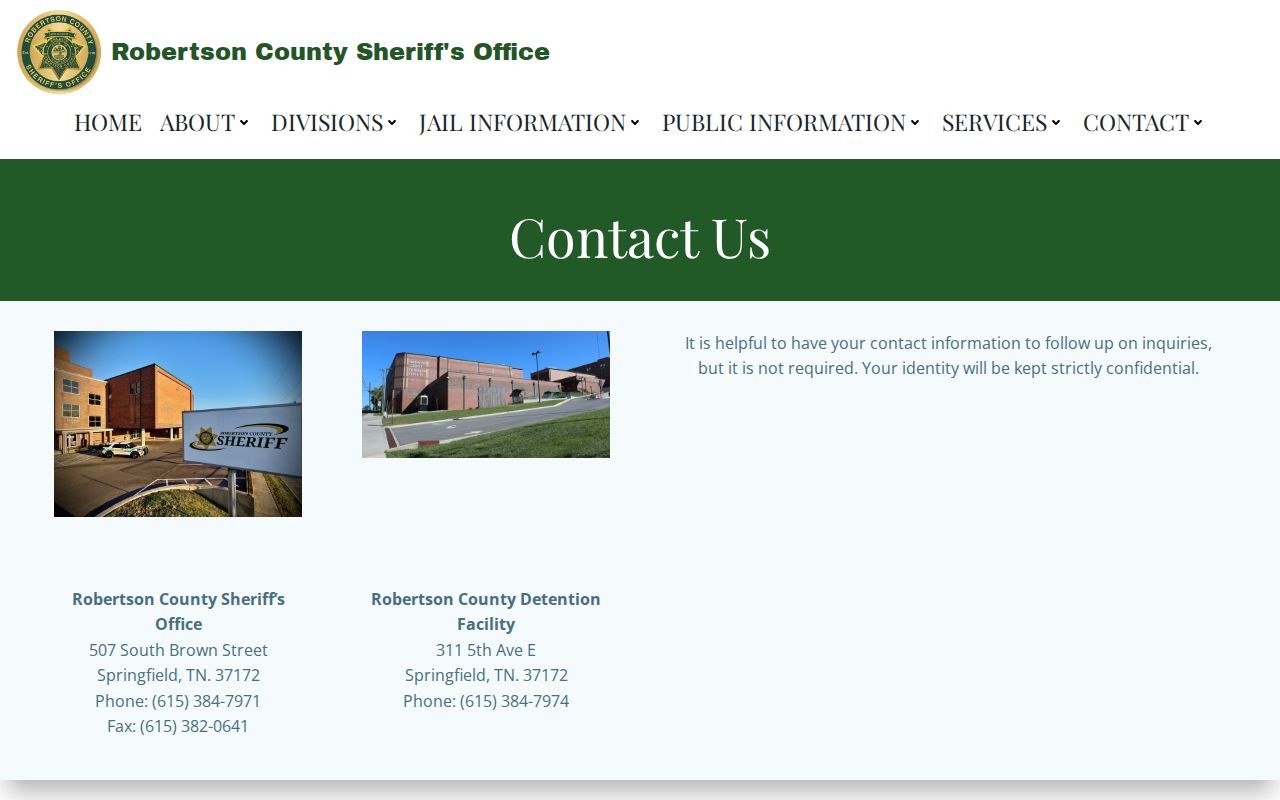
That split shows why a Robertson County report request and a current-custody call belong at different desks.
Criminal Records by City in Robertson County
City police departments create their own incident and arrest reports, and municipal courts keep ordinance and citation files. Springfield is the county seat and the main Robertson County court and booking hub. White House spans Robertson and Sumner Counties, so the incident site and charging court decide which county holds a case. Greenbrier keeps city police and municipal court records, while state criminal charges and custody move into the Robertson County chain.
Springfield Criminal History
18,782 · City police reports, municipal citations, and the county-seat records hub
White House Criminal History
12,982 · Two-county routing plus online and PDF city records requests
Greenbrier Criminal History
6,898 · Police and municipal files with county jail and court handoff
Robertson Record Demand and Growth
Robertson County recorded 72,803 residents in the 2020 Census. The estimate rose to 78,459 in 2024 and 80,175 in 2025, a 10.1 percent increase from the 2020 estimate base. More residents can mean more city calls, General Sessions filings, jail bookings, and records requests. The county still blends city police jurisdictions with broad rural sheriff coverage, so location remains a key search fact.
Official crime counts should be taken from one completed year in TBI CrimeInsight or the FBI Crime Data Explorer and labeled by agency and measure. Arrests, offenses, incidents, and clearances are not interchangeable. The research did not find a sound county table ready for use, so no mixed or unofficial crime total is presented.