
How to Check Criminal History in Springfield
Start with the event, not a broad name query. Springfield Police holds the incident or crash report it created. The Springfield Municipal Court clerk keeps a city citation or ordinance file. A custodial arrest moves to the Robertson County Detention Facility, while state charges go to General Sessions and may later reach Circuit Court. This split keeps each Springfield record tied to the office that made it.
- Identify whether Springfield Police, a Robertson County deputy, or another agency handled the event.
- Ask Springfield Police for the report by incident number, date, location, and involved party.
- Contact the municipal clerk if the paper names Springfield Municipal Court or a city-code citation.
- Use the county jail and court clerks for booking, state charges, judgment, and sentence.
- Use TORIS only when a broader Tennessee name-based history is needed, not as a substitute for the local file.
A person reviewing an old Springfield matter should also note the year. The county Archives can hold the pointer when a modern court search does not reach the file.
Springfield Criminal Records Hub
Springfield is both a city records jurisdiction and Robertson County's justice hub. The city was incorporated in 1796. Its 2025 state-certified population is 18,782, which makes it the county's largest municipality. The courthouse square, Sheriff's Office, Detention Facility, and county Archives place several distinct record custodians in the same city, yet none holds every part of a criminal event.
The official MTAS Springfield profile lists 254 municipal employees and weekday City Hall hours of 7:30 a.m. to 4:30 p.m. It also records a third-Tuesday governing meeting at 6 p.m. Those municipal facts help identify the city office, but they do not turn City Hall into the custodian for county cases.
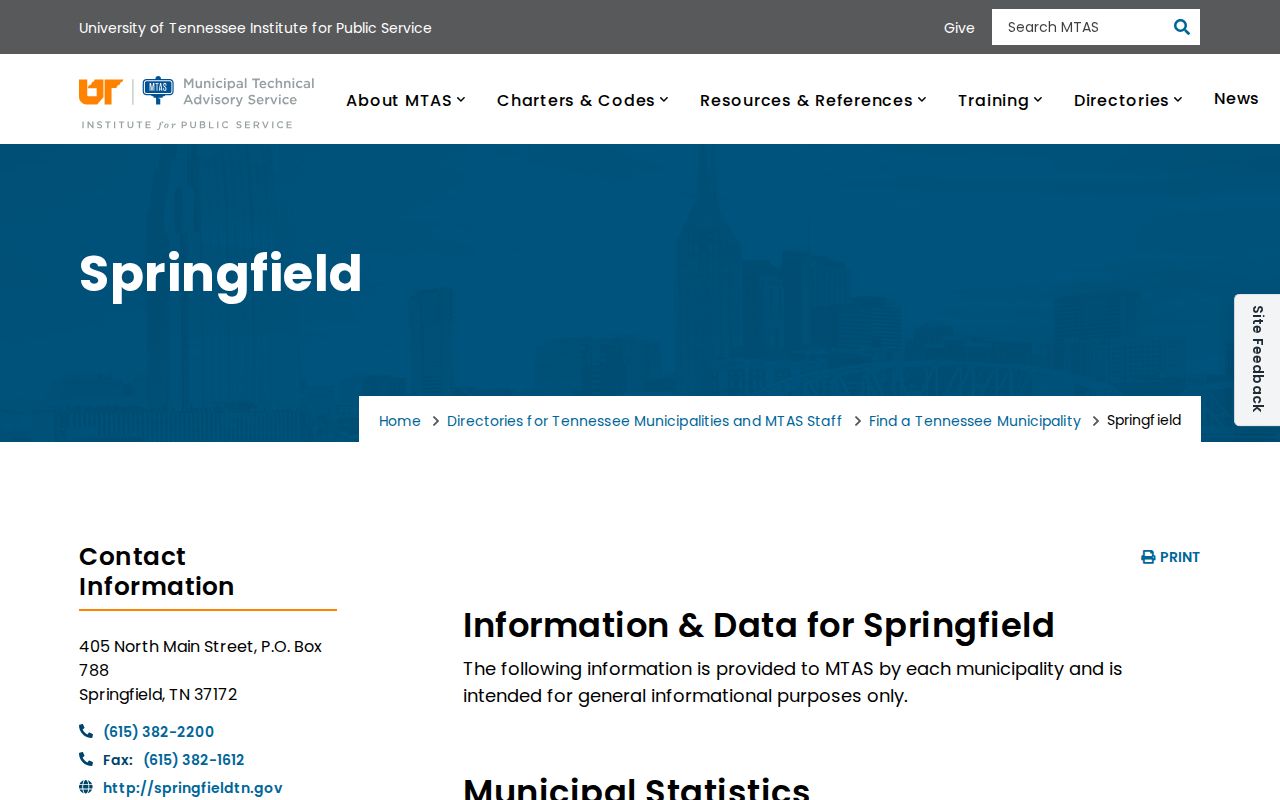
The state profile confirms Springfield's local government identity, which is the starting point for separating city records from Robertson County files.
The Springfield Police Department
Springfield Police creates city incident, crash, arrest, and citation records. Ask its records custodian for a defined existing report. Useful details include the incident number, date and time, exact location, names of involved parties, and the type of copy sought. State whether inspection or a copy is wanted, name a delivery preference, and ask for a cost estimate before the office does paid copy or review work.
No stable indexed Springfield police request form was captured in the research. That makes a direct call through the official city channel and a precise Tennessee Public Records Act request the sound fallback. Do not ask city staff to compile every mention of a person. Ask for a report or set of reports that staff can locate from known facts. The report can describe the police response and probable-cause basis, but it does not supply the final outcome of a prosecution.
Springfield Police Records
Use the official city Police page to confirm the current records contact, submission route, hours, and copy terms before making a Springfield report request.
Springfield Police or Sheriff Records
An address inside Springfield does not prove that Springfield Police made the report. Robertson County deputies, state troopers, or a task force may handle an event in or near the city. First read the citation, incident number, booking data, or dispatch information for the agency name. Send the report request to that agency, even when the later court case is filed at the Springfield courthouse.
If both Springfield Police and the Robertson County Sheriff's Office responded, each may hold a different record. Ask Springfield for the city officer's incident or supplemental report. Ask the sheriff's Records Division for a deputy report at 507 South Brown Street or by calling 615-384-7971. The county clerk owns the docket and judgment. These are separate public-record requests, not duplicate routes to one combined file.
For a crash, the Tennessee Department of Safety channel may also matter. Body-camera footage, dispatch audio, and CAD records should be narrowed by time and location because review and redaction work can be more involved. Note: The investigating agency owns its report even when a different office books the person or prosecutes the charge.
Arrests and Bookings in Springfield
A Springfield custodial arrest ordinarily moves to the Robertson County Detention Facility at 311 Fifth Avenue East. Jail staff create the intake record, booking number, custody status, initial charge list, bond and hold data, and release entry. Springfield Police keeps the arrest or incident narrative. That means a police report request and a booking inquiry answer different questions about the same event.
The sheriff's public Inmate Info route did not expose a stable indexed search URL in the research. If it does not load, call the Detention Facility at 615-384-7974. TN SAVIN can provide custody status and allow notice of release, transfer, or escape. A current-custody screen is not a full Springfield arrest history because someone may have been released, cited, transferred, booked under a variant name, or held for another system.
Medical screening, housing and security classifications, and protected identifiers are not ordinary public booking fields. An arrest charge is still an allegation. Later prosecutors or a grand jury may amend, dismiss, no-bill, or replace it. The dedicated Robertson County arrest history resource covers the county booking and custody chain in depth.
Springfield Arrest Record Timeline
The first Springfield record is usually the officer's event report. If there is a custodial arrest, the person then enters county booking, where fingerprints, property, screening, holds, bond data, and release records are created. A judicial commissioner or judge produces the first appearance and bond record. General Sessions then opens the early court file for state charges.
A felony can move from a Sessions complaint and preliminary stage to grand-jury review. If an indictment issues, the Circuit Court file becomes the key record for arraignment, motions, plea or trial, judgment, and sentence. The clerk later reports the disposition for linkage with the TBI arrest cycle. A delay or failed link can make the Springfield police report, county docket, and statewide history look inconsistent for a time.
Springfield arrest flow: Police Report › County Booking › General Sessions › Grand Jury › Circuit Judgment
Springfield Municipal Court Records
Springfield Municipal Court handles city ordinance and citation matters. It does not try Robertson County felony cases. Research found no verified public name-search portal, so use the official court page to confirm the current clerk, court session, payment method, and copy instructions. A citation number, name, and date give the clerk a more exact way to locate the city file.
| Court Name | Springfield Municipal Court. |
|---|---|
| Case Types Heard | City ordinance and citation matters within the municipal court's authority. |
| Case Lookup Channel | Clerk or counter request through the official city court page; no verified public name portal. |
| What the Docket Shows | Citation identifier, parties, scheduled events, city charge, disposition, and payment activity when maintained in the public file. |
| Copies & Fees | Ask the clerk for current inspection, copy, certification, delivery, and cost terms. |
Read the charging authority before treating the result as a state criminal conviction. A city-code disposition and a Tennessee Code criminal judgment are not the same record.
Springfield Citation or County Case
The face of the citation should name the court. If it directs the person to Springfield Municipal Court and cites a city ordinance, begin with the municipal clerk. If it names General Sessions or states a Tennessee criminal charge, use the Robertson County clerk. A custodial arrest can also produce a jail entry even when the court route is not yet clear.
| Record Clue | Springfield Starting Point | Likely Scope |
|---|---|---|
| City-code citation | Municipal Court clerk | Ordinance or city citation file |
| Tennessee charge or Sessions number | Robertson County clerk | State misdemeanor or felony preliminary file |
| Police incident number | Springfield Police records custodian | Officer's event report |
| Booking number | Robertson County Detention Facility | Custody, bond, hold, and release data |
Do not infer the court solely from where a person was held. The Robertson jail serves county, state, and federal judicial systems. Physical custody can sit in Springfield while the prosecuting docket belongs to another court.
Where Springfield Records End Up
Springfield Police retains the city report. County court clerks create the prosecution file when state charges are filed. Booking staff transmit reportable fingerprints into Tennessee's state chain, and the clerk later sends dispositions for linkage by the Tennessee Bureau of Investigation. The systems share facts, but each record keeps its own purpose and timing.
Record flow: Springfield Police Department › Robertson County Courts › Tennessee Bureau of Investigation
For recent activity, the police and jail are the fast local sources. For the outcome, read the judgment or certified disposition. TORIS is a $29 name-based Tennessee history drawn from fingerprint-reported arrests and linked dispositions. It does not search aliases during matching and is not a fingerprint identity check. County and state routes should stay at supporting depth on a Springfield page; the Robertson County criminal-history hub carries the full cross-system detail.
Older Springfield Criminal Records
Springfield's long role as county seat makes the Robertson County Archives a useful second stop for an older state case. Its catalog names Criminal Court Papers from 1900 through 2016, General Sessions Court Index records from 1947 through 1994, and Circuit Court civil and criminal testimony transcriptions from 1932 through 1962. Use Keyword, Name, or Field Search.
A catalog hit can be only an index entry. Copy the record group, name, dates, and reference details, then ask Archives or the clerk for the paper beneath it. Do not send a Springfield municipal citation to the county Archives by default. First confirm that the matter became a county court case rather than staying in the city's limited docket.
When no result appears, try the surname and first name separately, narrow the record group, and search a range around the event year. Note: A failed modern name search does not rule out an indexed Springfield-related case stored as an older paper file.
Pick the Springfield Record Custodian
A common error is asking the nearest office for every record. Springfield Police cannot certify a Circuit Court judgment. The county jail does not own the police narrative. Municipal Court does not hold a felony indictment. TBI does not replace the local file when the question concerns one Springfield event. The record's creator or legal custodian is the right office.
- Police report
- Request from Springfield Police when its officers handled the event.
- Booking record
- Ask the Robertson County Detention Facility for custody, charge, bond, and release data.
- Municipal docket
- Use Springfield Municipal Court for city ordinance and citation matters.
- Criminal judgment
- Use the Robertson County court clerk for a state case disposition or certified copy.
- Historical index
- Search Robertson County Archives when the clerk route does not reach an older file.
Giving the custodian a case, incident, citation, or booking number can save time. If no number is known, provide a full name, exact place, and the tightest date span supported by the event.
Public Access Rules
The Tennessee Public Records Act gives Tennessee citizens a right to inspect state and local public records, subject to exceptions. Springfield may ask for government-issued identification to verify citizenship. An inspection request need not be written, while a copy request may be required in writing or on a form. If prompt production is not practical, the custodian should act within seven business days by producing the record, denying it with a legal basis, or giving an estimate of production time.
Key Statutes:
Tenn. Code Ann. §10-7-503 sets the citizen access and response framework for Springfield public records.
Tenn. Code Ann. §10-7-504 collects exceptions that require a custodian to withhold or redact protected content.
Tenn. Code Ann. §38-6-120 supports TBI dissemination of Tennessee criminal-history checks through TORIS.
Inspection is generally free. Copies and labor may cost money under the city's policy and state guidance, so ask for an estimate and set a cost ceiling. Active-investigation content, confidential victim or minor information, medical data, security-sensitive jail facts, juvenile files, and sealed or expunged records can remain unavailable. A redacted Springfield report may still be public in part. Ask the custodian to cite the legal basis for material that is withheld.